|
Weather for Mariners
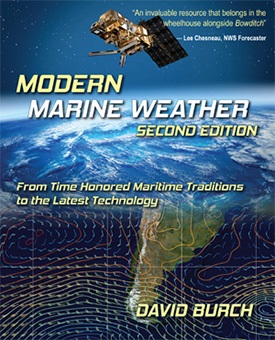 Here
it is! The course you’ve been waiting for. Here
it is! The course you’ve been waiting for.
Weather for Mariners (ASA 119)
teaches boaters how to take
weather into account in the planning and navigation
of voyages, both local and global.
Captain Tony Green does seminars on the subject at the
Minneapolis Boat Show. Tony received rave reviews
for the Weather for Mariners course. “This was the most
thorough, complete and valuable course on marine
weather I’ve ever seen or taken,” Captain Sue E.
Anyone who ventures onto the water should do it
with weather confidence and weather strategies. This
weather course is highly beneficial.
Weather is a vast subject with many facets, but
when it comes to marine weather it really boils down
to wind prediction. Wind drives a sailboat and
creates the waves. Severe weather and associated
strategies are a concern, but sailors spend far more
time dealing with too little wind than too much
wind. In addition to avoiding too much wind, this
course teaches you how to find more wind when there
is little to none to be had.
Students will learn to
integrate marine weather into their overall
navigation using the latest technological tools as
well as traditional maritime skills such as the
barometer, wind, clouds, and sea state observations.
Also included are the theory, properties and
behavior of squalls, fronts, storms, hurricanes, fog
and global wind patterns and the study of weather
maps.
 With
weather being the most pressing factor in a journey
by sail, this course is a must-do. With
weather being the most pressing factor in a journey
by sail, this course is a must-do.
Prerequisites: None
Classroom Location:
Sailcrafters
7450 Oxford St
St Louis Park, MN 55426
Directions to Sailcrafters
From Hwy 169
Take exit for Hwy 7
East
Hwy 7 east to Louisiana Ave S
At the traffic circle, take the 2nd exit onto Louisiana Ave S
Turn right onto Oxford St, Sailcrafters will be on the right.
Directions to Sailcrafters
From Hwy 100
Take exit for Hwy 7
West
Hwy 7 west to Louisiana Ave S
Turn right onto Louisiana Ave S, make a U-turn
At the traffic circle, take the 2nd exit and stay on Louisiana
Ave S
Turn right onto Oxford St, Sailcrafters will be on the right.
Classroom Location:
Windmill Marina
16065 32nd Street South
Afton, MN 55001
Directions:
From I-94 and County
Road 18 / Hwy 95
• Take County Road 18 South (Saint Croix Trail N)
from Hwy I94 for 4.4 miles (south)
• Turn left at 32nd Street South (just in the town
of Afton)
• Go through Marina entrance (approximately 1 block from Saint Croix
Trail N) to parking lot A (on left) and then to
building in middle of parking lot. Park in front of
building.
Course Fee: $249, including materials and
ASA certification upon successful completion. $35 discount
for couples sharing materials (any two people signing up together).
CLASS SCHEDULE
Fall
2017 (Dates are subject to change)
3-hour evening sessions 6-9PM (or as close as possible) OR Saturdays 9AM-4PM, with lunch break
W1-Sailcrafters:
Thursdays 11/2, 11/9, 11/16, 11/30, 12/7, 12/14/2017 (exam)
W2-Sailcrafters:
Saturdays 12/2, 12/9, 12/16/2017 (exam)
Independent Study Class
/ Correspondence. This
course can be completed by those unable to attend our regular
classes. We
like to interview
prospective students in
this category. Please Call. Cost $169.
Throughout the course we emphasize how you combine your own
observations of wind, sea, clouds, and barometer to better
interpret the official forecasts obtained from radio or
facsimile as well as make your own forecast if you lose the
official sources. We also help you develop practical rules of
thumb that will contribute to sound, efficient decision making
underway.
Topics include:
- Radio sources of weather and how to
interpret them
- Basic principles of Highs and Lows —
ridges and troughs
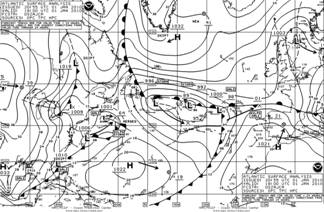
- Weather maps: what kinds, how to get
them, how to read them.
- All about barometers
- Fronts, squalls, storms, and hurricanes
- Tropical versus extratropical cyclones
- Sides of a storm and storm avoidance
- Cloud ID and interpretation
- Fog — sea fog and radiation fog
- Global winds — prevailing westerlies,
trade winds,
doldrums, monsoons, roaring forties, screaming fifties,
polar easterlies
- Pacific High, Aleutian Lows, and counterparts around
the world
- Local winds and weather, including Lake
Superior
- How to use a barometer, wind shifts, and clouds for
shipboard forecasting
- Waves and swells, significant wave height, sea state
forecasting
- Beaufort scale
- Winds and terrain — land and sea breezes, shoreline
wind shifts, drainage winds, channeled winds, convergence
zones
- How to predict wind shifts inland and at sea
- Use of the internet for weather study and planning
|
Course
Outline for Evening Class
Day 1:
Introduction. Pressure and Wind.
Day 2:
Global Wind and Currents. Strong Wind Systems.
Day 3:
Clouds, Fog, and Sea State. Wind and Terrain.
Day 4:
Weather
Maps Review. Sources of Weather Data.
Day 5:
On-board Forecasting and Tactics. Special Topics.
Test Review.
Day 6:
Examination.
Course
Outline for Saturday Class
Day 1:
Introduction. Pressure and Wind. Global Wind and Currents. Strong Wind Systems.
Day 2: Clouds, Fog, and Sea State. Wind and Terrain. Weather Maps Review. Sources of Weather Data.
Day 3:
On-board Forecasting and Tactics. Special Topics. Review and Examination.
Call
Northern Breezes Sailing School at 763-542-9707 to register or
with questions.
Northern Breezes
Sailing School
3949
Winnetka Ave. N.
Minneapolis, MN 55427
Call For Free Brochure (763) 542-9707
American Sailing
Association
Sailing School
TOP
|
